
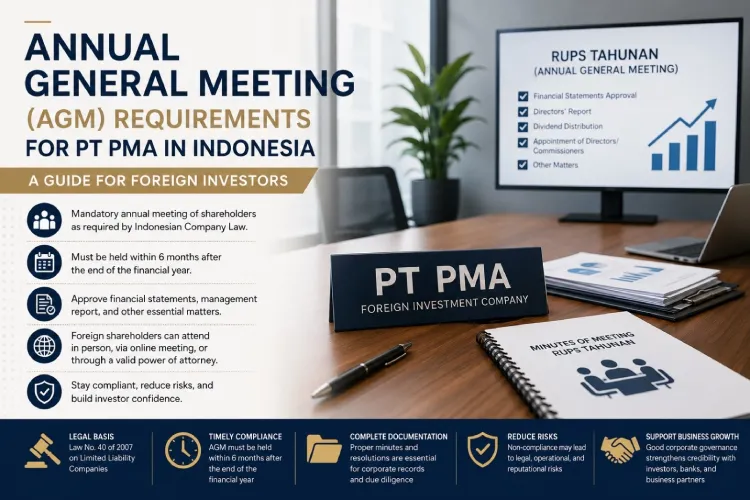
Establishing a PT PMA (Foreign Investment Company) in Indonesia is only the first step toward doing business successfully. Once incorporated, every company must comply with ongoing corporate governance obligations, one of the most important being the Annual General Meeting (AGM), known in Indonesia as the Annual General Meeting of Shareholders (Rapat Umum Pemegang Saham Tahunan or RUPS Tahunan).
Many foreign investors mistakenly believe that if their company is inactive or has only one or two shareholders, they are exempt from holding an AGM. However, Indonesian corporate law requires companies to maintain proper corporate governance, and failing to comply may create legal and administrative issues in the future.
This guide explains the AGM requirements for PT PMA, the legal framework, and best practices to help foreign investors keep their companies compliant.
What Is an Annual General Meeting (AGM)?
An Annual General Meeting (AGM) is the yearly meeting of a company’s shareholders to review the company’s performance and make important corporate decisions.
During the AGM, shareholders typically:
- Approve the annual financial statements.
- Review the directors’ management report.
- Grant approval and release of responsibility (acquit et de charge) to the Board of Directors and Board of Commissioners, where appropriate.
- Decide on dividend distribution, if any.
- Appoint or replace directors and commissioners (if required).
- Discuss other matters affecting the company.
The AGM forms an essential part of corporate governance and demonstrates that the company is operating in accordance with Indonesian law.
Is an AGM Mandatory for PT PMA?
Yes. Under Law No. 40 of 2007 on Limited Liability Companies, every Indonesian limited liability company (Perseroan Terbatas or PT), including PT PMA, is generally required to hold an Annual General Meeting of Shareholders.
The AGM should be held within six months after the end of the company’s financial year, unless otherwise provided by applicable laws or regulations.
Even if the company has only one or two shareholders or has not yet commenced business operations, maintaining proper corporate documentation remains an important aspect of compliance.
What Must Be Approved at the AGM?
Although the agenda may vary depending on the company’s activities, an AGM commonly includes approval of:
- Annual financial statements
- Directors’ annual report
- Company’s operational performance
- Dividend distribution (if applicable)
- Appointment or reappointment of directors and commissioners
- Auditor appointment (where required)
- Other corporate matters requiring shareholder approval
The resolutions adopted during the AGM should be properly documented in the company’s corporate records.
Can Foreign Shareholders Attend Remotely?
Yes. Foreign shareholders who are unable to travel to Indonesia may generally participate through legally permitted mechanisms, including:
- Video conference or other electronic meeting platforms (subject to the company’s Articles of Association and applicable regulations)
- Written shareholders’ resolutions, where legally permissible
- Representation through a proxy under a valid Power of Attorney
The appropriate method depends on the company’s constitutional documents and the nature of the resolutions being adopted.
What Documents Are Typically Required?
Preparing for an AGM usually involves several corporate documents, including:
- Notice of the AGM
- Agenda of the meeting
- Annual financial statements
- Directors’ report
- Attendance list
- Shareholders’ resolutions
- Minutes of Meeting
- Supporting corporate documents, where necessary
Maintaining complete and accurate documentation is essential, particularly during audits, due diligence exercises, or regulatory reviews.
What Happens If a Company Does Not Hold an AGM?
Failure to maintain proper corporate governance may create various practical and legal challenges, including:
- Incomplete corporate records
- Difficulties during legal due diligence
- Delays in mergers or acquisitions
- Banking and financing complications
- Increased regulatory scrutiny
- Corporate governance concerns for investors and business partners
Although the consequences depend on the specific circumstances, maintaining annual corporate documentation is considered a best practice for every PT PMA.
Annual Compliance Checklist for PT PMA
In addition to holding an AGM, companies should regularly review their overall compliance obligations.
A typical annual compliance checklist includes:
- Hold the Annual General Meeting (AGM)
- Prepare annual financial statements
- Maintain statutory corporate records
- Review OSS and business licensing information
- Update shareholder or director information, if applicable
- Ensure tax reporting obligations have been fulfilled
- Review business activities against registered KBLI classifications
- Maintain proper corporate resolutions and minutes
Regular compliance reviews help reduce legal risks and improve corporate governance.
Why Corporate Compliance Matters for Foreign Investors
Corporate compliance is not merely a legal formality. Well-maintained corporate records can significantly benefit a company by:
- Facilitating investment and fundraising
- Supporting bank account applications
- Simplifying due diligence during business transactions
- Demonstrating good corporate governance
- Reducing legal and regulatory risks
- Building confidence with investors and commercial partners
Foreign investors planning long-term operations in Indonesia should view annual compliance as an investment in the company’s stability and credibility.
Conclusion
Holding an Annual General Meeting is a fundamental corporate governance requirement for PT PMA in Indonesia. Regardless of the size of the business or the number of shareholders, maintaining proper annual corporate records helps protect the company, supports future business transactions, and demonstrates compliance with Indonesian company law.
Foreign investors should ensure that AGMs are conducted on time, properly documented, and supported by accurate corporate records. Seeking professional legal assistance can help companies navigate Indonesian corporate requirements efficiently and avoid unnecessary compliance risks.
How Bali Legals Can Assist
Our corporate legal team assists foreign investors and Indonesian companies with:
- Annual General Meeting (AGM) preparation
- Shareholders’ resolutions and meeting minutes
- Corporate secretarial services
- PT PMA corporate compliance
- Company law advisory
- Director and shareholder changes
- Corporate document review
- General corporate governance support
Whether you have recently established a PT PMA or have operated in Indonesia for several years, maintaining proper annual corporate compliance is essential for protecting your business and supporting its long-term success.