
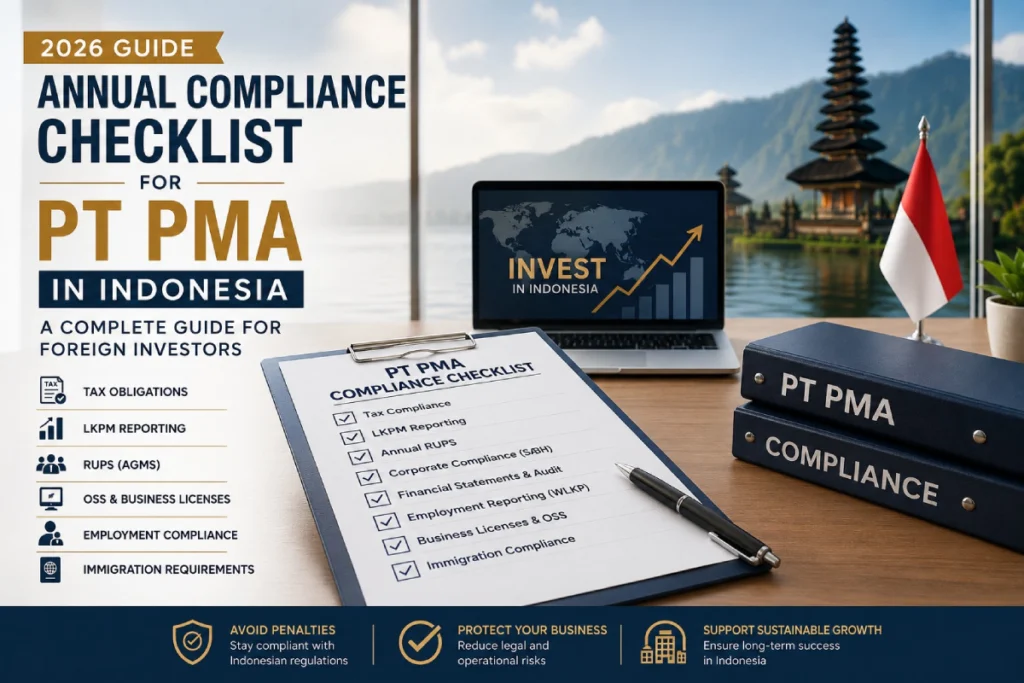
a Complete Guide for Foreign Investors (2026)
Establishing a PT PMA (Foreign-Owned Company) in Indonesia is only the first step. Once the company is operational, foreign investors must comply with a range of ongoing legal, tax, corporate, and regulatory obligations.
Failure to comply may result in administrative sanctions, tax penalties, OSS restrictions, difficulties in obtaining permits, or complications during future corporate actions.
This guide outlines the key annual compliance requirements every PT PMA should monitor in 2026.
1. Monthly Tax Compliance
PPh 21 (Employee Income Tax)
Companies employing staff in Indonesia are required to:
- Calculate employee income tax (PPh 21)
- Withhold and remit taxes to the Directorate General of Taxes
- Submit monthly tax reports
Failure to comply may trigger tax audits and administrative penalties.
VAT Reporting (PPN)
Companies registered as PKP (Taxable Entrepreneurs) must:
- Issue tax invoices through e-Faktur
- File monthly VAT returns
- Reconcile VAT input and output transactions
Withholding Taxes (PPh 23 / PPh 26)
PT PMA companies making payments for services, royalties, dividends, or certain cross-border transactions may be required to withhold and report taxes accordingly.
2. BPJS Employment and Health Contributions
Employers must ensure timely payment of:
- BPJS Kesehatan (Health Insurance)
- BPJS Ketenagakerjaan (Employment Social Security)
Employee data and salary information should also remain updated throughout the year.
3. Quarterly LKPM Reporting
One of the most important obligations for foreign investors is the submission of the Investment Activity Report (LKPM).
LKPM reports generally include:
- Investment realization
- Business activities
- Workforce information
- Operational progress
Reports are submitted through the OSS-RBA system and are monitored by BKPM.
Consistent failure to submit LKPM reports may lead to warnings, business license restrictions, or other administrative consequences.
4. Annual Corporate Income Tax Return (SPT Tahunan Badan)
Every PT PMA must submit its annual corporate tax return.
The filing generally includes:
- Financial statements
- Fiscal reconciliation
- Tax payment records
- Supporting documentation
For companies using the calendar fiscal year, the deadline is typically 30 April of the following year.
5. Annual General Meeting of Shareholders (RUPS Tahunan)
Indonesian company law requires PT companies to hold an Annual General Meeting of Shareholders (RUPS).
The meeting typically approves:
- Annual financial statements
- Profit distribution
- Directors’ reports
- Corporate governance matters
The RUPS must generally be held within six months after the end of the financial year.
6. Annual SABH Reporting Requirements
Recent regulatory developments have increased compliance requirements through the Legal Entity Administration System (SABH).
Companies should ensure:
- Annual corporate approvals are properly documented
- Required notarial deeds are prepared
- Corporate reports are submitted within applicable deadlines
Failure to comply may affect the company’s ability to process future corporate changes such as shareholder amendments, director appointments, or capital increases.
7. Financial Statements and Audit Requirements
PT PMA companies should maintain proper accounting records and prepare annual financial statements in accordance with Indonesian accounting standards.
Depending on business scale and regulatory requirements, an external audit may also be necessary.
Accurate bookkeeping is essential for:
- Tax compliance
- Investor reporting
- Due diligence processes
- Future financing activities
8. Employment Reporting (WLKP)
Companies employing staff in Indonesia are generally required to submit annual manpower reports.
This reporting is frequently required when:
- Applying for work permits
- Renewing employment-related licenses
- Undergoing labor inspections
9. Review Business Licenses and OSS Data
At least once per year, companies should verify:
- NIB validity
- OSS-RBA information
- KBLI business classifications
- Office address records
- Shareholder information
- Director and commissioner data
Any inconsistency between OSS, SABH, tax records, and company documents may create compliance issues during audits or future corporate transactions.
10. Review Immigration and Expatriate Compliance
Foreign-owned companies employing expatriates should review:
- KITAS validity
- Work permits
- Sponsor arrangements
- Position eligibility requirements
Renewals should be planned well before expiration dates.
Practical Compliance Calendar
Monthly
- PPh 21 reporting
- VAT reporting (if PKP)
- BPJS contributions
- Withholding tax reporting
Quarterly
- LKPM submission
Annually
- Corporate Income Tax Return (SPT Tahunan Badan)
- Annual RUPS
- SABH reporting
- WLKP reporting
- Financial statement preparation
- Corporate document review
- Immigration compliance review
Final Thoughts
Indonesia continues to strengthen post-investment supervision and corporate governance requirements for PT PMA companies. Compliance is no longer limited to tax reporting; regulators increasingly integrate data across OSS, SABH, tax authorities, manpower systems, and investment reporting platforms.
For foreign investors, maintaining a structured compliance calendar is one of the most effective ways to avoid penalties, reduce legal risk, and ensure smooth business operations in Indonesia.
If your company requires assistance with PT PMA compliance, corporate secretarial services, LKPM reporting, tax coordination, shareholder resolutions, or corporate restructuring, professional legal support can help ensure all regulatory obligations are fulfilled accurately and on time.