
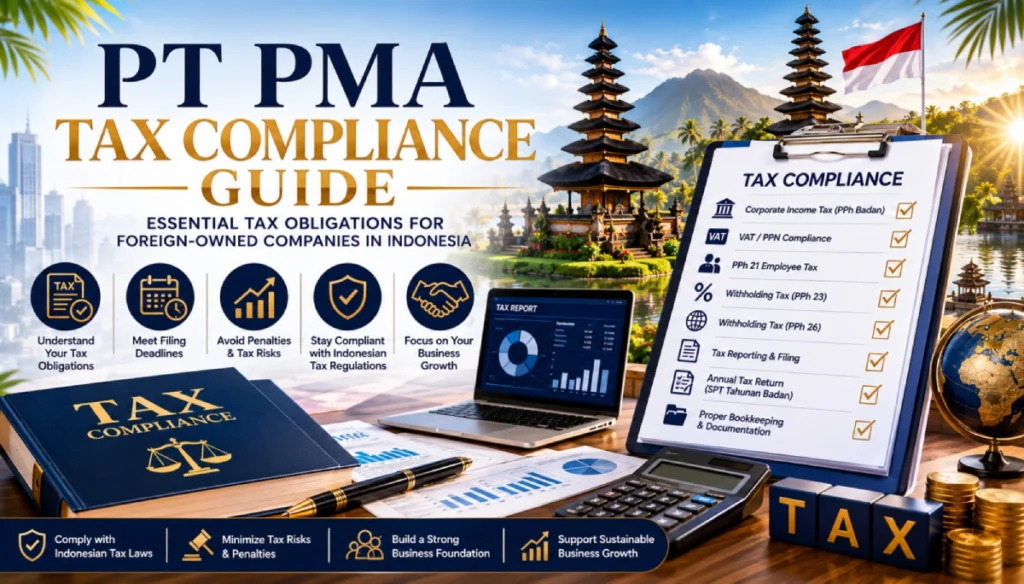
Essential Tax Obligations for Foreign Owned Companies in Indonesia
Indonesia remains one of Southeast Asia’s most attractive destinations for foreign investment. However, operating a PT PMA (Foreign-Owned Limited Liability Company) involves more than obtaining business licenses and commencing operations. Companies must also comply with various tax obligations imposed by Indonesian law.
Failure to meet tax compliance requirements can result in administrative sanctions, financial penalties, tax audits, and reputational risks. This guide outlines the key tax obligations every PT PMA should understand.
Understanding Tax Compliance for PT PMA Companies
A PT PMA is generally subject to the same taxation framework as domestic companies operating in Indonesia. Once registered, the company must obtain a Taxpayer Identification Number (NPWP) and comply with ongoing tax reporting and payment obligations.
Tax compliance typically includes:
- Corporate Income Tax (PPh Badan)
- Value Added Tax (VAT/PPN)
- Employee Income Tax (PPh 21)
- Withholding Taxes (PPh 23 and PPh 26)
- Annual Corporate Tax Returns
- Tax bookkeeping and record retention
Corporate Income Tax (PPh Badan)
PT PMA companies are subject to Corporate Income Tax on profits generated from business activities in Indonesia.
Taxable income generally includes:
- Revenue from business operations
- Service fees
- Rental income
- Investment-related income
- Other taxable gains
Companies must maintain proper accounting records and prepare financial statements to calculate taxable income accurately.
Employee Income Tax (PPh 21)
Employers are responsible for withholding and remitting employee income tax on behalf of their employees.
This obligation applies to:
- Indonesian employees
- Foreign employees working in Indonesia
- Directors receiving remuneration
- Commissioners receiving compensation
Companies must calculate, pay, and report employee taxes on a monthly basis.
Value Added Tax (VAT / PPN)
Companies registered as Taxable Entrepreneurs (PKP) must comply with VAT obligations.
VAT compliance generally includes:
- Issuing electronic tax invoices
- Collecting VAT from customers
- Reporting VAT transactions monthly
- Maintaining proper supporting documentation
Businesses involved in trading, services, hospitality, construction, and real estate activities should carefully assess their VAT obligations.
Withholding Tax (PPh 23)
PPh 23 generally applies to certain domestic payments made by companies.
Examples include:
- Professional services
- Consulting services
- Technical services
- Royalties
- Rental payments for specific assets
The company is responsible for withholding the applicable tax before making payment to the recipient.
Withholding Tax on Foreign Payments (PPh 26)
PT PMA companies frequently engage in cross-border transactions with overseas shareholders, consultants, licensors, or affiliated entities.
PPh 26 may apply to:
- Royalties
- Dividends
- Interest payments
- Technical service fees
- Certain overseas payments
Foreign investors should also consider whether applicable tax treaties may reduce withholding tax rates.
Monthly Tax Reporting Obligations
Most PT PMA companies are required to submit monthly tax reports.
Monthly compliance may include:
- PPh 21 reporting
- PPh 23 reporting
- PPh 26 reporting
- VAT reporting (if registered as PKP)
Timely filing is essential to avoid administrative penalties.
Annual Corporate Tax Return (SPT Tahunan Badan)
Every PT PMA must submit an Annual Corporate Income Tax Return.
The filing generally includes:
- Financial statements
- Fiscal reconciliation
- Tax payment records
- Supporting schedules and documentation
Accurate annual reporting helps minimize tax risks and facilitates future audits, financing activities, and due diligence processes.
Transfer Pricing Considerations
PT PMA companies engaging in transactions with related parties should pay particular attention to transfer pricing regulations.
Common related-party transactions include:
- Management service fees
- Licensing arrangements
- Shareholder loans
- Intercompany transactions
Tax authorities may request documentation demonstrating that transactions are conducted at arm’s length and reflect market conditions.
Common Tax Compliance Mistakes
Foreign investors often encounter tax issues due to:
Poor Record Keeping
Incomplete accounting records can create difficulties during audits and tax reviews.
Late Tax Filings
Late submissions may trigger administrative penalties and increased scrutiny from tax authorities.
Misclassification of Transactions
Improper classification of expenses, services, or related-party payments can result in additional tax assessments.
Failure to Review Tax Treaty Benefits
Many foreign investors overlook available treaty protections that may reduce withholding tax exposure.
Best Practices for PT PMA Tax Compliance
To maintain compliance, foreign-owned companies should:
- Maintain accurate accounting records
- Conduct regular tax reviews
- Monitor filing deadlines
- Reconcile financial and tax data regularly
- Review related-party transactions carefully
- Seek professional legal and tax advice when necessary
Conclusion
Tax compliance is a fundamental aspect of operating a PT PMA in Indonesia. Beyond meeting legal obligations, a strong compliance framework helps reduce business risks, improve corporate governance, and support sustainable growth.
Foreign investors who proactively manage their tax obligations are better positioned to avoid penalties, maintain good standing with regulatory authorities, and focus on expanding their business operations in Indonesia.